



Private Day Tour from Porto: Guimarães, Braga and Bom Jesus
布拉加, 葡萄牙
Experience a private full-day journey from Porto through Guimarães and Braga, combining medieval heritage, cathedral landmarks and the freedom to choose monument and experience tickets during booking.
Annullierungspolitik
Lies vor der Buchung die Bedingungen des Anbieters weiter unten.
Dauer 10 Stunden
Dauer laut Angabe des Anbieters.
Sprachen
Portugiesisch, Englisch, Spanisch, Französisch
Größe der Gruppe
1–7 Reisende
Vollständige Beschreibung
Discover northern Portugal through a private full-day journey from Porto that brings together the symbolic origins of Guimarães and the religious and architectural weight of Braga in one clearly structured experience. This itinerary is designed to feel coherent from beginning to end, linking Portugal’s formative medieval identity with one of the country’s most influential ecclesiastical centres, before closing at the hillside sanctuary of Bom Jesus do Monte. The result is a day that feels cultured, scenic and quietly memorable, with strong historical substance and a clear sense of progression throughout.
The morning begins with a drive north from Porto, where the historical frame of the day can be introduced alongside the broader landscape of the Vinho Verde region. This opening gives context to the route before arrival in Guimarães, widely understood as the symbolic cradle of Portugal. A guided walking route through the UNESCO-listed historic centre makes the city immediately legible, beginning with a compact cluster around Oliveira Square, the Church of Oliveira and Saint James Square, where civic memory, architecture and everyday life still coexist in a compact medieval setting.
From there, the route continues along Rua de Santa Maria, traditionally regarded as the city’s oldest street, creating a natural transition toward the institutions that shaped early Portugal. The experience may then continue with separately selected visits to the Palace of the Dukes of Bragança and the Castle of Guimarães, with a short stop at São Miguel Church helping to reinforce the symbolic weight of the area. Together, these sites give depth to Guimarães not only as a picturesque historic centre, but as a place closely tied to the formation of the Portuguese nation.
Around midday, the journey continues to Braga, where lunch is intentionally left flexible so the centre of the day can adapt naturally to appetite, pace and preference. This may mean a relaxed sit-down meal, a shorter pause before continuing, or time in the city centre before the afternoon walking sequence begins.
In the afternoon, the experience turns to Braga, a city where public space, religious architecture and urban refinement work together with unusual clarity. The walking route begins with the Arco da Porta Nova and the Garden of Santa Bárbara, offering a strong opening sequence that introduces Braga’s civic identity without unnecessary distance. From there, the route continues to the Braga Cathedral, where a guided visit may be selected separately during booking. Depending on the selected option, this experience may include key sections such as the Coro Alto and the chapels, providing a richer understanding of the cathedral’s role in the religious and architectural history of the north.
The day’s final chapter leads to Bom Jesus do Monte, one of the region’s most memorable sanctuary settings. A separately selected ride on the historic Bom Jesus funicular may be included during booking, turning the ascent itself into part of the experience. At the top, the sanctuary may be visited through its exterior and interior spaces, while the iconic staircase setting brings together devotion, landscape design and viewpoint in one of the most recognisable images of northern Portugal.
By the time you return to Porto in the early evening, the impression is of having crossed three deeply connected layers of northern Portuguese identity in one day: the symbolic origins of Guimarães, the ecclesiastical presence of Braga, and the devotional landscape of Bom Jesus do Monte. Together, they create a private tour that feels balanced, varied and quietly distinctive, leaving behind a stronger sense of the region’s atmosphere, heritage and identity.
Transparency note: meals are not included. Monument and experience tickets are selected separately in the second step of the booking process, so you can choose exactly what you want to include. This ensures clear pricing, with no hidden costs, no unnecessary mark-ups, and no commissions added by us or our partners.
Ablauf
Guimarães – The Cradle of Portugal and the Strength of Medieval Memory. Set in the heart of the Minho region, Guimarães is one of Portugal’s most symbolically important cities, closely associated with the formation of the nation in the 12th century. Its exceptionally preserved historic centre, recognised by UNESCO in 2001, gives the city a rare continuity, where squares, churches, streets, and monuments still express the atmosphere of a medieval urban core. Today, the municipality of Guimarães has a resident population of 156,513 inhabitants, giving the city a strong civic scale while preserving the legibility and intimacy of its historic heart. This balance between national significance and daily urban life is one of the reasons Guimarães feels at once monumental and deeply human. This is a stop that gives the day immediate historical clarity and emotional weight. For travellers seeking the roots of Portuguese identity in a city that still feels lived and authentic, Guimarães offers one of the most rewarding introductions in northern Portugal.
Oliveira Square, Oliveira Church and Saint James Square – The Living Core of Medieval Guimarães. The cluster formed by Largo da Oliveira, the Church of Our Lady of Oliveira, and Saint James Square offers one of the clearest openings to the character of historic Guimarães. The origins of the church go back to the monastery founded by Countess Mumadona Dias around the 10th century, while the surrounding squares preserve the civic and religious atmosphere of a medieval city still strongly legible today. For visitors, this area immediately explains why Guimarães feels so coherent on foot. The architecture, the sense of enclosure, and the relationship between sacred and civic landmarks — including the Padrão do Salado, a Gothic monument linked to the Battle of the Salado of 1340, and the arcaded frontage of the Old Town Hall, developed between the 14th and 15th centuries — create a strong first reading of the historic centre. This is a stop that adds atmosphere, orientation, and historical texture to the day from the very beginning. Oliveira Square, the Oliveira Church, and Saint James Square offer one of the most elegant introductions to the medieval soul of Guimarães.
Optional – Alberto Sampaio Museum – Sacred Art and the Early Heart of Guimarães. The Alberto Sampaio Museum is one of the most rewarding optional cultural visits in Guimarães, especially for travellers interested in sacred art and the earliest layers of the city’s identity. It was officially created in 1928, and it occupies the site of the primitive monastery founded by Mumadona Dias, later transformed into the collegiate church associated with Our Lady of Oliveira. For visitors, the museum offers more than a collection. Its cloister, medieval rooms, and religious treasures help reveal how Guimarães grew from monastic origins into a civic and dynastic centre, adding artistic and institutional depth to the walking route without disturbing the rhythm of the day. This is an optional stop that adds depth, artistic value, and strong historical continuity to the itinerary. The Alberto Sampaio Museum offers one of the clearest ways to connect the devotional heritage of Guimarães with the origins of the city itself.
Rua de Santa Maria – The Street That Connects Everyday Life to the Origins of the Nation. Rua de Santa Maria, traditionally regarded as the oldest street in Guimarães, is one of the city’s most evocative urban corridors. Already documented in the 12th century, it forms a direct link between the lower civic spaces and the monuments associated with Portugal’s earliest political and dynastic history. For visitors, the street works as more than a route between stops. Its noble houses, convent-related buildings, Gothic traces, and carefully preserved façades turn walking into interpretation, revealing how daily life, social hierarchy, and institutional power once shaped the city through architecture and urban form. This is a stop that adds rhythm, intimacy, and narrative flow to the itinerary. Rua de Santa Maria offers one of the most rewarding ways to feel Guimarães as a city where history is still read through the street itself.
Palace of the Dukes of Braganza – Noble Residence and the Language of Power. The Palace of the Dukes of Braganza is one of Guimarães’ most important monuments and one of the strongest expressions of aristocratic power in northern Portugal. Built in the 15th century by Afonso, Count of Barcelos, later 1st Duke of Braganza, the palace stands out for its imposing volume, its distinctive skyline of tall cylindrical chimneys, and its evocation of northern European manor architecture. For visitors, the palace offers a reading of power through space rather than legend alone. Its great halls, ceremonial rooms, and fortified-house character reveal how status, lineage, and political ambition were expressed in domestic form, giving depth to the historical identity of Guimarães beyond the castle itself. This is a stop that adds refinement, historical range, and strong visual presence to the day. The Palace of the Dukes of Braganza offers one of the clearest ways to understand how noble authority helped shape the north of Portugal.
Church of São Miguel do Castelo – A Small Monument with Foundational Resonance. The Church of São Miguel do Castelo is modest in scale, yet powerful in national symbolism. Built in the early 12th century in a restrained Romanesque style, local tradition closely associates it with the baptism of Afonso Henriques, the first king of Portugal. For visitors, the church offers an unusually concentrated encounter with the founding myths of the country. Its simplicity, proximity to the castle, and quiet atmosphere make it feel less like a major monument and more like a place where memory and legend have been allowed to remain close to the ground. This is a stop that adds intimacy, symbolic weight, and narrative precision to the itinerary. The Church of São Miguel do Castelo offers one of the most memorable examples of how Guimarães connects national identity to place.
Castle of Guimarães – Fortress, Origin Story and the Symbol of a Nation. The Castle of Guimarães is the defining monument of the city and one of the strongest symbolic landmarks in Portugal. Its origins go back to the fortification built in the 10th century under Countess Mumadona Dias, later reinforced in the 12th century during the period associated with Count Henry, D. Teresa, and the formation of the first Portuguese kingdom. For visitors, the castle’s strength lies in its clarity. Its walls, towers, and elevated setting allow the story of Guimarães to be grasped almost instantly, not as abstraction but as stone, defence, and territorial origin. The monument remains powerful precisely because it is so direct. This is a stop that adds force, simplicity, and lasting historical resonance to the day. The Castle of Guimarães offers one of the clearest and most unforgettable images of Portugal’s beginnings.
Optional – Church of Our Lady of Consolation and Holy Steps – Baroque Grandeur Beyond the Historic Core. The Church of Our Lady of Consolation and Holy Steps is one of Guimarães’ most striking later monuments, rooted in a small hermitage first built in 1576 and expanded into the present church, completed in 1785. It is an important example of Baroque spatial design in Guimarães, later enhanced in the 19th century by its twin towers, staircase, and related devotional structures. For visitors, this church offers a different reading of the city from the medieval core. Its theatrical façade and broader urban setting bring a more processional and monumental character to the experience, showing how Guimarães continued to evolve architecturally well beyond its foundational period. This is an optional stop that adds Baroque richness, visual impact, and stylistic variety to the itinerary. The Church of Our Lady of Consolation and Holy Steps offers a rewarding complement to the earlier monuments of Guimarães.
Optional – Penha Sanctuary – Faith, Granite Landscape and Panoramic Height. The Penha Sanctuary, set on Penha Mountain above Guimarães at around 617 metres above sea level, is one of the city’s most meaningful optional panoramic and devotional visits. The present sanctuary was designed by Marques da Silva, completed at the end of 1945, and inaugurated on 14 September 1947. For visitors, Penha combines sanctuary atmosphere, woodland setting, and broad views over the surrounding region. It offers a more natural and elevated reading of Guimarães, where granite outcrops, greenery, and open vistas create a memorable contrast with the compact medieval centre below. This is an optional stop that adds landscape, calm, and panoramic reward to the day. The Penha Sanctuary offers one of the most attractive elevated perspectives around Guimarães.
Braga – Religious Grandeur, Civic Elegance and the Layered Life of the North. Set in the historic heart of northern Portugal, Braga is one of the country’s oldest and most influential cities, with roots in Roman Bracara Augusta and a long-standing role as a major religious centre. Its churches, gardens, arches, and ceremonial urban spaces give the city a strong sense of historical continuity, where ecclesiastical influence and civic refinement remain closely intertwined. Today, the municipality of Braga has a resident population of 203,519 inhabitants, making it one of Portugal’s most dynamic urban centres. Even with this contemporary scale, the city centre remains highly walkable and visually coherent, allowing visitors to experience Braga through a sequence of elegant and meaningful stops. This is a stop that brings breadth, sophistication, and strong architectural presence to the day. For travellers seeking a northern Portuguese city where religion, heritage, and urban life still speak clearly to one another, Braga offers one of the richest experiences in the country.
Arco da Porta Nova – A Ceremonial Threshold into Braga. The Arco da Porta Nova is one of Braga’s most recognisable civic landmarks and one of the clearest symbolic entries into the historic centre. Opened in the city wall in the early 16th century on the initiative of Archbishop D. Diogo de Sousa, it acquired its present late Baroque and Rococo form in the 18th century, associated with André Soares. For visitors, the arch works as both monument and urban signal. Passing through it creates an immediate sense of transition into the ceremonial and historic fabric of Braga, where the city’s civic confidence and visual refinement become legible from the very first steps. This is a stop that adds elegance, orientation, and a memorable sense of arrival to the itinerary. The Arco da Porta Nova offers one of the most effective openings to the historic centre of Braga.
Garden of Santa Bárbara – Ornament, Colour and Urban Refinement. The Garden of Santa Bárbara is one of Braga’s most visually attractive public spaces, set beside the medieval wing of the former archiepiscopal palace, whose surviving sections date from the 14th and 15th centuries. Its carefully composed flowerbeds, ornamental layout, and architectural backdrop give it a distinctly refined urban presence within the city centre. For visitors, the garden offers a brief but rewarding pause between monuments. It brings softness, colour, and proportion to the route, while also revealing Braga’s ability to combine religious and institutional heritage with a polished civic landscape. This is a stop that adds grace, visual charm, and a lighter rhythm to the day. The Garden of Santa Bárbara offers one of the most elegant small-scale moments in central Braga.
Braga Cathedral – The Spiritual and Historical Core of the City. The Braga Cathedral, or Sé de Braga, is the oldest cathedral in Portugal and the city’s most important religious monument. Construction of the present cathedral began in the late 11th century, and over time it accumulated Romanesque, Gothic, Manueline, and Baroque layers, making it not only a sacred building, but also a condensed architectural history of the country. For visitors, the cathedral offers both scale and depth. Its chapels, choir, cloistered atmosphere, and artistic details create a visit that feels simultaneously monumental and intimate, while the tombs associated with Count Henry and D. Teresa reinforce Braga’s connection to the earliest dynastic history of Portugal. This is a stop that adds gravity, continuity, and exceptional heritage value to the itinerary. The Braga Cathedral offers one of the most complete and meaningful religious experiences in Portugal.
Optional – Sanctuary of Our Lady of Sameiro – Monumental Devotion Above Braga. The Sanctuary of Our Lady of Sameiro is one of the great Marian sanctuaries of Portugal and one of Braga’s most important optional devotional and panoramic visits. Construction began in 1863, continued into the 20th century, and the sanctuary was elevated to the rank of minor basilica by Pope Paul VI in 1964. For visitors, Sameiro offers a monumental and elevated setting where pilgrimage architecture meets broad regional views. Its staircase, open forecourt, wooded surroundings, and strong devotional atmosphere make it a powerful complement to Braga’s cathedral and to the more theatrical ascent of Bom Jesus do Monte. This is an optional stop that adds Marian devotion, breadth, and scenic reward to the day. The Sanctuary of Sameiro offers one of the most impressive high-altitude spiritual settings in the Braga region.
Bom Jesus do Monte – Sanctuary, Landscape and the Grandeur of Sacred Ascent. The Sanctuary of Bom Jesus do Monte, recognised by UNESCO in 2019, is one of the most extraordinary sacred landscapes in Portugal and one of Braga’s defining monuments. Developed from the 15th century onward and largely shaped in the Baroque, Rococo, and Neoclassical periods, it combines architecture, devotion, stairways, terraces, woodland, and views in a composition that is both theatrical and deeply spiritual. For visitors, Bom Jesus is memorable not only because of the sanctuary itself, but because of the way the entire ascent is designed as experience. The setting turns approach into meaning, making architecture, topography, and devotion work together in a way that feels highly intentional and emotionally powerful. This is a stop that adds climax, beauty, and a strong sense of completion to the day. Bom Jesus do Monte offers one of the most iconic and rewarding finales in northern Portugal.
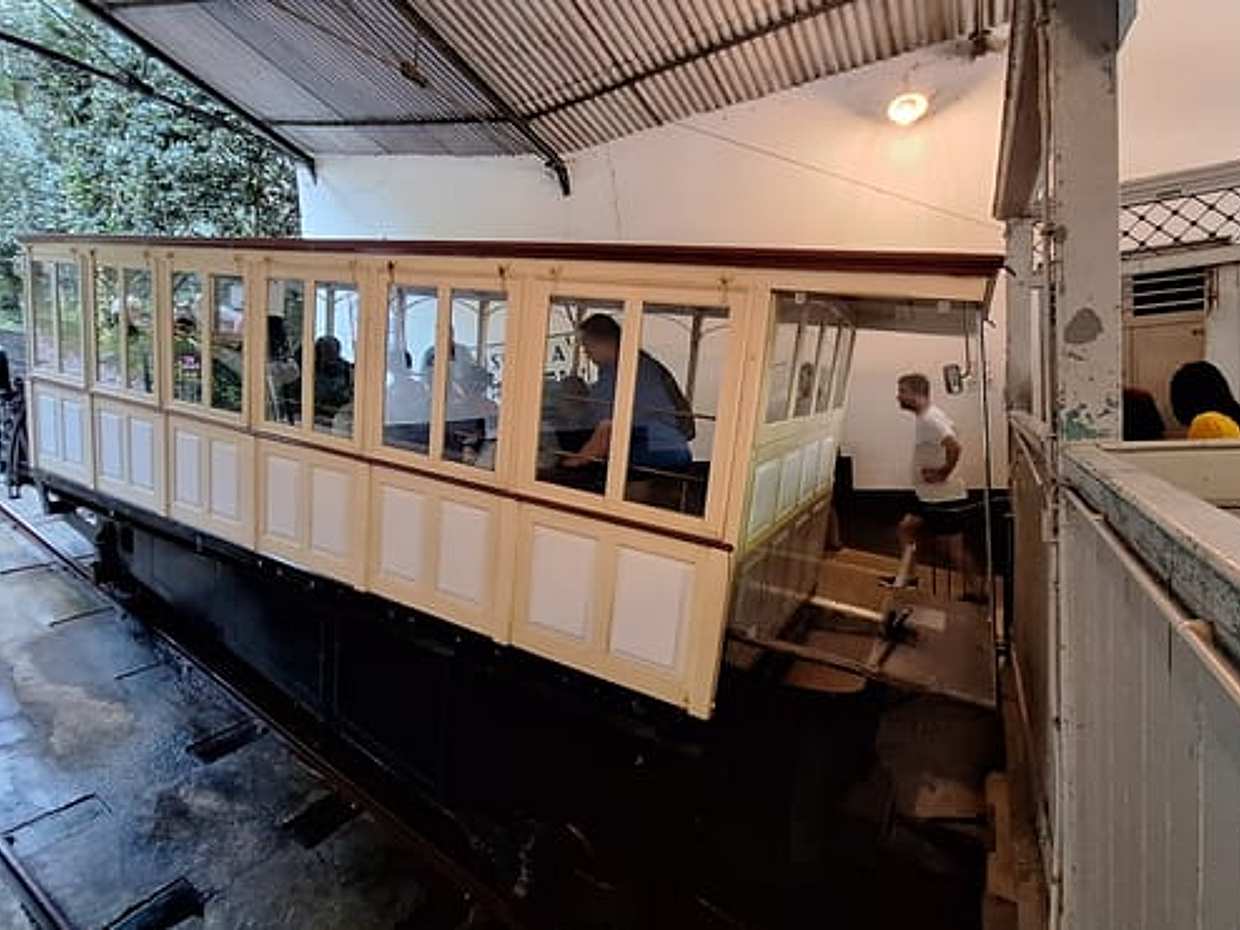
Bom Jesus Funicular – A Historic Ascent to the SanctuaryThe Bom Jesus Funicular is one of the most distinctive elements of the sanctuary experience and a rare surviving example of historic engineering still integrated into devotional practice. Opened in 1882, it is celebrated as the world’s oldest water-powered funicular still in operation and the first funicular built in the Iberian Peninsula. For visitors, the ride does more than solve the climb. It preserves the sense of transition between city and sanctuary, lower ground and sacred height, making the approach feel ceremonial, gentle, and distinctly local. This is a stop that adds charm, rarity, and a strong experiential detail to the itinerary. The Bom Jesus Funicular offers one of the most memorable ascents in Portugal.
Sanctuary and Staircase of Bom Jesus – Architecture, Devotion and the Final View. The sanctuary church and the famous staircase of Bom Jesus do Monte form one of the most recognisable architectural sequences in Portugal. The staircase rises through a celebrated symbolic composition traditionally read through the Five Senses, the Three Virtues, and the final sacred approach, creating a layered ascent of fountains, chapels, terraces, and sculptural rhythm before the church above. For visitors, this final sequence offers both architectural satisfaction and emotional release. The staircase gives movement and symbolism to the ascent, while the sanctuary and its surroundings provide the calm, altitude, and visual breadth that make the close of the day feel complete. This is a stop that adds ceremony, visual power, and a memorable conclusion to the tour. The sanctuary and staircase of Bom Jesus offer one of the most iconic final impressions in Portugal.
Was ist inbegriffen?
Inbegriffen
- 导游
- 接送
- 🔏 - Fully private and personalized tour, reserved exclusively for your group
- 📍 - Free pickup available from hotels, Airbnbs, train stations, cruise ports, and central locations — details confirmed after booking
- 🚘 - Premium late-model Mercedes-Benz vehicles (or equivalent) that are clean, safe, and exceptionally comfortable
- 🎖️ - Official Regional Interpreter Guide and Certified Tourism Driver
- 📶 - Free onboard internet
- 👶 - Free child seats available – If traveling with children under 8 years old or under 144 cm, please inform us so we can prepare the appropriate seats
- 🧂 - Complimentary water bottles
- 🍬 - Extra comfort amenities included
- 📩 - Instant booking confirmation
Nicht inbegriffen
- 💵 - Tips: Gratuity is not included or required, but appreciated if you enjoyed the experience
- 🔖 - Admission fees to wineries, monuments, attractions, and experiences not listed in the inclusions
Wichtige Informationen
Treffpunkt
布拉加, 葡萄牙
Nicht vergessen
🧏♂️ - Professional guide-drivers fluent in English, Spanish, Portuguese, and French. German- or Italian-speaking guide-drivers may be requested, subject to availability (not guaranteed). 🧏♀️ - Sign Language interpreters can be arranged upon request, subject to availability and advance notice (additional cost applies). ♿ - Collapsible wheelchairs and strollers can be accommodated in the vehicle trunk 🐕🦺 - Guide dogs are always welcome, and the experience is accessible for passengers with limited eyesight 🤹♂️ - Local insights and personalized recommendations from friendly, knowledgeable drivers 🚭 - Smoke-free experience ⛈️ - Destinations and itineraries may be adjusted due to weather, road conditions, or at the guide’s discretion 🍷 - Visits to wineries, monuments, attractions, and experiences may vary based on availability, private events, or holidays 📜 - Personal accident and liability insurance included - Private full-day journey from Porto through Guimarães, Braga and Bom Jesus do Monte - Discover the symbolic origins of Portugal in the UNESCO centre of Guimarães - Possibility to add separately selected visits to the Palace of the Dukes of Bragança and the Castle of Guimarães - Flexible lunch time in Braga - Walking route through Braga’s civic and architectural landmarks - Possibility of a separately selected guided visit to the Braga Cathedral - Option to add the historic Bom Jesus funicular during booking - A balanced day linking medieval origins, cathedral heritage and sanctuary landscape
Annullierungspolitik
5% charge if cancelled within 23976 hours of start. 100% charge if cancelled within 24 hours of start.
Dein Gastgeber
VE
Verified Local Host
Bei GetExperience seit 2026
Das könnte dir auch gefallen
Ab€400.00 / Gruppe