

Assuan, Egitto
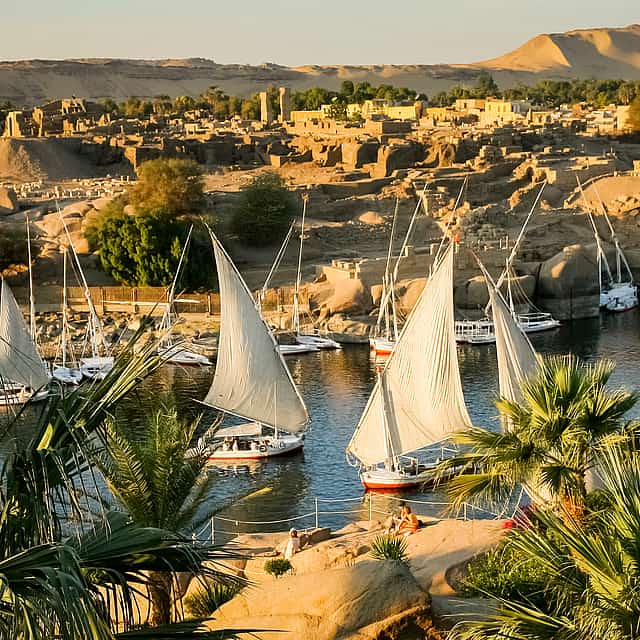
Aswan-dæmningstur og Felucca-sejltur
2 ore
23 visualizzazioni di recente
Da€85.80/ personaFull Day Private Tour To Luxor From Aswan
Politica di cancellazione
Prima di prenotare, leggi le condizioni del fornitore qui sotto.
Durata 12 ore
Durata indicata dal fornitore dell'esperienza.
Lingue
inglese, tedesco, arabo, italiano, francese, spagnolo
Dimensione del gruppo
Da 1 a 15 viaggiatori
At 6:00 AM Pickup from your Hotel or Nile Cruise in Aswan by Tour guide then you will be transferred by Private A/C Vehicle to Luxor where it is 280 K/M North Aswan
The Valley of the Kings (Egyptian Arabic: وادى الملوك Wādī el-Mulūk; Coptic: ϫⲏⲙⲉ[1] Džēme [ˈʃɪ.mæ]), also known as the Valley of the Gates of the Kings (وادى ابواب الملوك Wādī Ebwāb el-Mulūk),[2] is an area in Egypt where, for a period of nearly 500 years from the Eighteenth Dynasty to the Twentieth Dynasty, rock-cut tombs were excavated for pharaohs and powerful nobles under the New Kingdom of ancient Egypt
The mortuary temple of Hatshepsut (Egyptian: Ḏsr-ḏsrw meaning "Holy of Holies") is a mortuary temple built during the reign of Pharaoh Hatshepsut of the Eighteenth Dynasty of Egypt.[b] Located opposite the city of Luxor, it is considered to be a masterpiece of ancient architecture.[c] Its three massive terraces rise above the desert floor and into the cliffs of Deir el-Bahari. Her tomb, KV20, lies inside the same massif capped by El Qurn, a pyramid for her mortuary complex. At the edge of the desert, 1 km (0.62 mi) east, connected to the complex by a causeway lies the accompanying valley temple. Across the river Nile, the whole structure points towards the monumental Eighth Pylon, Hatshepsut's most recognizable addition to the Temple of Karnak and the site from which the procession of the Beautiful Festival of the Valley departed. The temple's twin functions are identified by its axes: its main east-west axis served to receive the barque of Amun-Re at the climax of the festival.
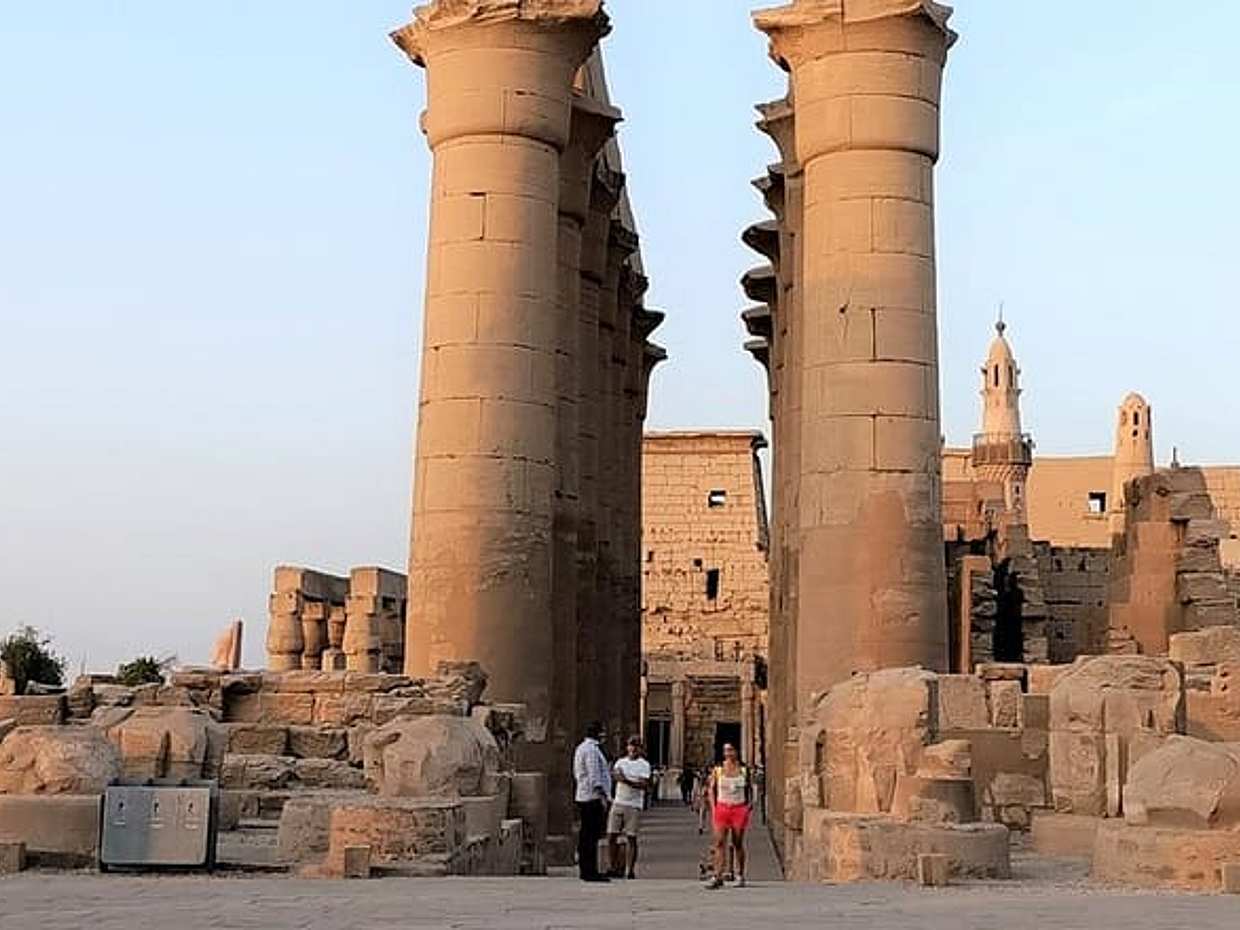
The Luxor Temple (Arabic: معبد الأقصر) is a large Ancient Egyptian temple complex located on the east bank of the Nile River in the city today known as Luxor (ancient Thebes) and was constructed approximately 1400 BCE. In the Egyptian language it was known as ipet resyt, "the southern sanctuary". It was one of the two primary temples on the east bank, the other being Karnak.[1] Unlike the other temples in Thebes, Luxor temple is not dedicated to a cult god or a deified version of the pharaoh in death. Instead, Luxor temple is dedicated to the rejuvenation of kingship; it may have been where many of the pharaohs of Egypt were crowned in reality or conceptually (as in the case of Alexander the Great, who claimed he was crowned at Luxor but may never have traveled south of Memphis, near modern Cairo).
The Karnak Temple Complex, commonly known as Karnak (/ˈkɑːr.næk/),[1] comprises a vast mix of temples, pylons, chapels, and other buildings near Luxor, Egypt. Construction at the complex began during the reign of Senusret I (reigned 1971–1926 BCE) in the Middle Kingdom (c. 2000–1700 BCE) and continued into the Ptolemaic Kingdom (305–30 BCE), although most of the extant buildings date from the New Kingdom. The area around Karnak was the ancient Egyptian Ipet-isut ("The Most Selected of Places") and the main place of worship of the 18th Dynastic Theban Triad, with the god Amun as its head. It is part of the monumental city of Thebes, and in 1979 it was added to the UNESCO World Heritage List along with the rest of the city.[2] The Karnak complex gives its name to the nearby, and partly surrounded, modern village of El-Karnak, 2.5 kilometres (1.6 miles) north of Luxor.
The Colossi of Memnon (Arabic: el-Colossat or es-Salamat) are two massive stone statues of the Pharaoh Amenhotep III, which stand at the front of the ruined Mortuary Temple of Amenhotep III, the largest temple in the Theban Necropolis. They have stood since 1350 BC, and were well known to ancient Greeks and Romans, as well as early modern travelers and Egyptologists.[1][2] The statues contain 107 Roman-era inscriptions in Greek and Latin, dated to between AD 20 and 250; many of these inscriptions on the northernmost statue make reference to the Greek mythological king Memnon, whom the statue was then – erroneously – thought to represent.[
Transfer to your Hotel in Aswan or even to Aswan airport in case if you would leave Aswan on that day
Assuan, Egitto
Not wheelchair accessible Not stroller accessible Not suitable for pets Infants must not sit on laps Not recommended for people with back problems Not recommended for pregnant travelers Not recommended for people with heart conditions Entrance fees -Depending on the Tour Options Chosen Our guide will be waiting for customers in the lobby holding a sign
Verified Local Host
Su GetExperience dal 2026
Assuan, Egitto
2 ore
23 visualizzazioni di recente
Da€85.80/ persona
Assuan, Egitto
9 ore
12 visualizzazioni di recente
Da€171.59/ persona
Assuan, Egitto
9 ore
18 visualizzazioni di recente
Da€171.59/ persona
Assuan, Egitto
10 ore
21 visualizzazioni di recente
Da€252.87/ persona
Assuan, Egitto
7 ore
41 visualizzazioni di recente
Da€99.34/ persona
Assuan, Egitto
11 ore
13 visualizzazioni di recente
Da€233.00/ persona
Assuan, Egitto
5 ore
10 visualizzazioni di recente
Da€135.47/ persona
Assuan, Egitto
3 h 45 min
11 visualizzazioni di recente
Da€44.25/ persona
Assuan, Egitto
4 ore
Da€54.19/ persona
Assuan, Egitto
2 ore
11 visualizzazioni di recente
Da€117.41/ personaDa€198.69 / gruppo