


2 Days Private Ephesus and Pamukkale Tour from Istanbul
Cankurtaran, Alemdar Cd. No:2, 34122 Fatih/İstanbul, Türkiye
Explore Pamukkale & Ephesus on a 2-day tour filled with ancient wonders & natural beauty!
Cancellation policy
Review the supplier policy below before booking.
Duration 2 days
Duration supplied by the experience provider.
Languages
English, Spanish
Group size
2–15 travelers
Full description
Embark on a 2-day private tour from Istanbul to discover the wonders of Ephesus and Pamukkale, blending history, nature, and cultural heritage.
Day 1: Begin with an early morning transfer to Istanbul Airport for your flight to Denizli. Upon arrival, journey to the breathtaking Pamukkale, known as the "Cotton Castle," where you’ll experience the soothing thermal waters and explore the ancient city of Hierapolis, a UNESCO World Heritage Site. After the tour, transfer to Kuşadası for an overnight stay.
Day 2: Dive into the rich history of Ephesus, one of the best-preserved Greco-Roman cities, and visit the sacred House of the Virgin Mary, a revered pilgrimage site. At the end of the day, transfer to Izmir Airport for your evening flight back to Istanbul, followed by a hotel transfer.
This tour offers a seamless, personalized experience, making it perfect for history and nature enthusiasts.
Itinerary
Ephesus Tour from Kusadasi
Ephesus; Ancient Greek city of Asia Minor, near the mouth of the Menderes River, in what is today West Turkey, South of Smyrna (now Izmir). One of the greatest of the Ionian cities, it became the leading seaport of the region. Its wealth was proverbial. The Greek city was near an old center of worship of a native nature goddess, who was equated with the Greek Artemis, and c.550 B.C. a large temple was built. To this Croesus, who captured the city, contributed. When Lydians attacked their cities, Ephesians defended themselves by tying a rope from The Temple of Artemis. But it was not a good way to defend a city. Croesus of Lydia captured it easily however he did not destroy. The city reached the "Golden Age" and became a good model to the Antic World in culture and art, as well. Building of the Artemission was going on.Croesus had a great respect to Artemis and he donated 36 columns with sculptures in relief. Some parts of these sculptures are in the British Museum today.
The agora on the southern part of the Basilica is the State Agora, and was built in the Roman Period in the first century B.C. This agora was used not for commerce but for business, it played an important role as a meeting place for the governmental discussions. During the excavations in the northeast corner of the Agora were found a great number of graves from the 7th-6th centuries B.C and a stone-paved road, and a archaic sarcophagus of terra cotta. From this it is understood that in the archaic period this part of the Agora was used as the necropolis of Ephesus. There is a water reservoir at the corner of the Agora, which played an important role in Ephesus.
This building has the shape of a small theatre with the stage building, seating places and the orchestra.It had double function in use. First it was used as a Bouleuterion for the meetings of the Boulea or the Senate. The second fuction was the Odeum as a concert hall for the performances.It was constructed in the 2nd century A.D by the order of Publius Vedius Antonius and his wife Flavia paiana, two wealthy citizens in Ephesus. It had a capacity of 1500 spectators. It had 3 doors opening from the stage to the podium. The podium was narrow and one meter higher than the orchestra section. The stage building was two-storeyed and embellished with columns.The podium in front of the stage building and some parts of the seating were restored. The Odeon used to be enclosed with a wooden roof.
located towards the end of the Curetes Street, it was called the Hercules gate because of the relief of Hercules on it. It was brought from another place in the fourth century AD to its current place, but the relief on it dates back to the second century AD. Only the two side of the columns remain today and the other parts of it have not been found. The relief of the flying Nike in the Domitian Square is thought to also be a part of this gate. The Heracles Gate narrowed the access to the street, preventing the passage of vehicles.We can understand that from the Fourth Century, the street had become a pedestrian area.
It is one of the three main streets of Ephesus between The Hercules Gate till to the Celsus Library.This street took its name from the priests who were called as Curetes later.Their names were written in Prytaneion. There were fountains, monuments, statues and shops on the sides of the street. The shops on the south side were two-storied. Ephesus had many earthquakes, in which many structures including the Curetes Street were damaged. These damages especially on the columns were restored by the new ones, but after the earthquake in the 4th century, the columns were replaced by the other ones brought from different buildings in the city. The differences between the design of the columns can be seen today. The street has its appearance from the 4th century.
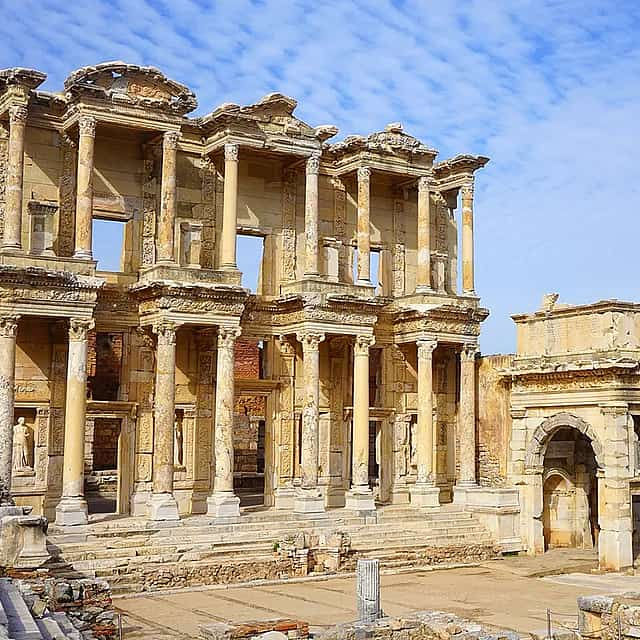
is one of the most beautiful structures in Ephesus. Celcius Library was built in 117 A.D. Celsus Library was a monumental tomb for Gaius Julius Celsus Polemaeanus, the governor of the province of Asia; from his son Galius Julius Aquila. The grave of Celsus was beneath the ground floor, across the entrance and there was a statue of Athena over it. Because Athena was the goddess of the wisdom. The scrolls of the manuscripts were kept in cupboards in niches on the walls. There were double walls behind the bookcases to prevent the them from the extremes of temperature and humidity. The capacity of the library was more than 12,000 scrolls. It was the third richest library in ancient times after the Alexandra and Pergamum.
House of Virgin Mary is located on the top of the "Bulbul" mountain 9 km ahead of Ephesus, the shrine of Virgin Mary enjoys a marvelous atmosphere hidden in the green. It is the place where Mary may have spent her last days. Indeed, she may have come in the area together with Saint John, who spent several years in the area to spread Christianity. Mary preferred this remote place rather than living in crowded place. The house of Virgin Mary is a typical Roman architectural example, entirely made of stones. In the 4th century AD, a church, combining her house and grave, has been built. The original two-stored house, which consisted of an anteroom (where today candles are proposed), bedroom and praying room (Christian church area) and a room with fireplace (chapel for Muslims). A front kitchen fell into ruins and has been restored in 1940's. Today, only the central part and a room on the right of the altar are open to visitors.
The Temple of Artemis is known as one of the Seven Wonders of the ancient world. It has been built in the areas of Ephesus on a flat area which has over the centuries turned into a swamp. If you visit Ephesus today, you can only see the ruins of the foundations of this marvelous construction of the Hellenistic Age, entirely made of marble and full of sculptured columns' capitals and shafts. The most beautiful remaining of this temple are today exhibited in the London British Museum. The oldest remaining found date back till the 6th century BC. It was surrounded by 36 huge columns, later enlarged upon the orders of the Lydia King, Kreisos, during the 6th century BC. Most of the exhibits in the London British Museum belong to this period.
Private Pamukkale Tour from Kusadasi
Pamukkale, meaning "cotton castle" in Turkish, is a natural site in Denizli in southwestern Turkey. The area is famous for a carbonate mineral left by the flowing of thermal spring water. It is located in Turkey's Inner Aegean region, in the River Menderes valley, which has a temperate climate for most of the year. The ancient Greco-Roman city of Hierapolis was built on top of the travertine formation which is in total about 2,700 metres (8,860 ft) long, 600 m (1,970 ft) wide and 160 m (525 ft) high. It can be seen from the hills on the opposite side of the valley in the town of Denizli, 20 km away. Known as Pamukkale (Cotton Castle) or ancient Hierapolis (Holy City), this area has been drawing visitors to its thermal springs since the time of Classical antiquity. The Turkish name refers to the surface of the shimmering, snow-white limestone, shaped over millennia by calcite-rich springs.
Pamukkale is a city is located in southwestern Turkey, known for its hot springs and travertines (terraces of carbonate materials that are typically a remnant of flowing water). In the total area, there are 17 thermal springs which range in temperatures from 35 degrees Celcius (95 degrees Fahrenheit) all the way up to 100 degrees Celcius (212 degrees Fahrenheit), so some of the pools will not be suitable for swimming. Don’t even get close to the hottest springs! Additionally, there is a museum in the city (that was originally a Roman bath) containing artefacts from all over the country (5 Lira entrance fee). Well worth a look. The city is located in the River Menderes valley and it has a temperate climate for the majority of the year. This conveniently makes it an ideal destination for those wanting to escape the cold.
Hierapolis is an ancient city located on the top of Pamukkale and is a World Heritage site. There is a mixture of Pagan, Roman, Jewish and early Christian influences. Since the hot springs of Pamukkale were used as a spa since the 2nd century, people came to Hierapolis to soothe their ailments and often retire and die. The ruins sprawl over a large area and there is a large necropolis filled with sarcophagi. The baths were made from large stone blocks and there are various open and closed areas linked together. The complex was constructed in the 2nd century and there are few historical facts known about the origin of the city. Many of the statues were transported to museums across the world and in 1970 a museum was built onsite.
Once a Roman bath, the Archeological Museum is near the Antique Pool atop the travertines at Pamukkale. If you’ve already visited the ruins of Hierapolis and the Roman theater, this is the next logical stop for anyone with a fairly lively interest in Roman archeology.
The Roman Theatre was built over two stages; the first theatre was destroyed by an earthquake, so the second was hollowed out of a slope in the mountain. Most of the stage is still visible, as well as some decorative panels and VIP seating areas. At full capacity, the theatre could hold 12,000 – 15,000 people. The theatre is divided by eight vertical passageways and nine aisles. The theatre is constantly undergoing excavation projects and new relics and statues depicting mythological figures are continually being discovered.
Situated above the Pamukkale white travertine pools is one particularly spectacular location fed by the same hot springs. Here you can bath in the same waters in which Cleopatra once swam! A professionally run modern spa facility allows you to enjoy these historical healing waters. Unlike the white water of the lower pools the Antique Pool favored by Cleopatra, Queen of Egypt, is pure clear warm water. Once it was surmounted by a Roman Temple to Apollo with ornate roof held up with Doric columns. Imagine how Cleopatra must have experienced this when you imagine it in it's glory day.
What’s included
Included
- Guide
- Meals: 1
- Transfer
- Lunch
- Breakfast
- PRIVATE TOUR, ensures a more personalized and exclusive experience tailored to your preferences
- PROFESSIONAL, LICENSED LOCAL TOUR GUIDE, Authorized by the Ministry of Tourism and Culture
- LUNCH IN THE COUNTRYSIDE, Enjoy a peaceful meal with authentic flavors in a serene rural setting.
- PRIVATE TRANSPORTATION, travel with separate driver in an air-conditioned, non-smoking van.
- PARKING FEES, all parking fees are included in the tour price, for your convenience
- HOTEL PICK-UP & DROP-OFF, convenient service as detailed in the itinerary.
- TO SKIP TICKET LINES, ask your guide to arrange tickets, pay on the spot
- DOMESTIC FLIGHT TICKETS, round way ticket from/to Istanbul
- ONE-NIGHT STAY, with bed and breakfast included, a perfect blend of convenience and relaxation
Not included
- Gratuities for the guide and the driver
- Personal Expenses
- Dinner
- Entrance Fees to the Museums and any Sites
- Beverages During Lunch
- Ephesus
- House of Virgin Mary
- Hierapolis / Pamukkale Ancient city
Important information
Meeting point
Cankurtaran, Alemdar Cd. No:2, 34122 Fatih/İstanbul, Türkiye
Don’t forget
Not suitable for pets Infants must not sit on laps Not wheelchair accessible Wheelchair accessible After booking your tour, please contact our team to confirm and arrange your pick-up location by reproviding your meeting point informations. This information will help us to prevent any delays and to make sure you have stress free experience from the beginning. If you encounter any difficulties finding a suitable time option, we will gladly assist you to ensure a smooth and enjoyable experience. MEETING POINT: İstanbul Airport or Sabiha Gökçen Airport and hotel lobbies for hotel guests. ---------------------------------- EXLUSIVE PRIVATE TOUR FOR YOUR PARTY ONLY - NO SHARING WITH OTHER GROUPS! ---------------------------------- Enjoy a personalized journey tailored to your party. Want to make it even more enjoyable? Invite friends to join and explore together on your terms with flexibility and comfort. ---------------------------------- ADVANTAGES OF PRIVATE TOURS OVER GROUP OR BUS TOURS ---------------------------------- A ONCE-IN-A-LIFETIME OPPURTUNITY: Your visit to site may be a unique experience. A private tour allows you to make the most of it with a personalized itinerary. ---------------------------------- FLEXIBLE AND PERSONALIZED SCHEDULE: Unlike group tours, this tourv give you full control over what to see, when to start, and when to conclude. You set the pace, ensuring a tour tailored to your interests. ---------------------------------- DEDICATED ATTENTION: In this tour, the guide focuses entirely on you and your group, ensuring you don’t miss any fascinating details or key highlights. ---------------------------------- NO WAITING OR DELAYS: You won’t have to wait for large groups to gather or stop for unforeseen situations. this tour keep the experience seamless and efficient. ---------------------------------- EXCLUSIVE COMFORT: Enjoy your own Van and expert local tour guide without the need to share with groups. ---------------------------------- HASSLE-FREE EXPERIENCE: Your guide will handle tickets and entry arrangements (if any), saving you time and effort while you focus on enjoying the ruins and museums. ---------------------------------- OPTIMAL LEARNING AND INTERACTION: this tour provide better opportunities to ask questions, hear the guide clearly, and engage deeply with the history and culture of the site.
Cancellation policy
Free cancellation if cancelled more than 144 hours before start. 50% charge if cancelled within 144 hours of start. 100% charge if cancelled within 48 hours of start.
Your host
VE
Verified Local Host
With GetExperience since 2026
You might also like
Istanbul Airport, Istanbul, Turkey
Istanbul Private Layover Tour from the Airport
8 hours
16 views recently
From€330.00/ person Request only
 Request only

 Request only
Istanbul, Turkey
Tour from Istanbul to Cappadocia by bus with accommodation in an unusual hotel and a hot air balloon flight
3 days
From€500.00/ person Request only
 Request only
Istanbul, Turkey
Cappadocia 2 days and 1 night from Istanbul Budget Tour Package
2 days
11 views recently
From€340.00/ person


From€626.53 / person