Antalya Museum, Kaleiçi and Karain Cave 2026: GetExperience
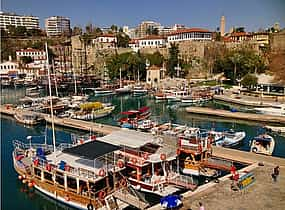
Antalya's cultural layer begins with Kaleiçi, a quarter of Ottoman houses with overhanging upper floors and inner courtyards, where nearly every lane ends either at a wall or at the sea. Walking tours through it gather Hadrian's Gate, the fluted minaret, a mosque made out of a Byzantine church, and the Hıdırlık tower on the cliff. The city museum stands on its own: it displays statues from Perge, including a whole hall of Roman gods found in the excavation of the theatre.
Outside the city, culture reaches further back in time. Karain cave north of Antalya is among the longest-inhabited sites in Anatolia: its layers accumulated from the Palaeolithic to antiquity, a rare case where tens of thousands of years show in a single section. Nearby stands the Kırkgöz caravanserai, a thirteenth-century Seljuk building on the old road inland where caravans spent the night.
The furthest cultural trip is Hierapolis above the Pamukkale terraces: an ancient spa town with a theatre, a temple and a necropolis, grown around hot springs, roughly three hours away. Practical notes: covered clothing is needed in the museum and mosques, Karain stays cool and damp all year, and Kaleiçi calls for sturdy shoes — the cobbles are uneven and the slope down to the harbour is noticeable.

Discover Other Art And Culture